



Heliswiss

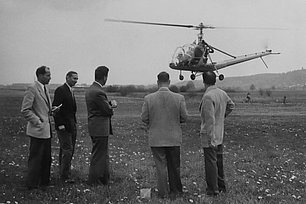
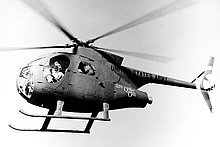
1955 - The helicopters Bell 47G HB-XAE and HB-XAK
1957 - The Agusta-Bell 47G2 HB-XAO at work in Valle Bavona/TI
1963 - The Agusta-Bell 204B HB-XBO during a material transport
1965 - The Agusta-Bell 47G3B-1 HB-XBZ at work
1970 - Transport of gravel with the Agusta-Bell 206A Jet Ranger HB-XCT
1972 - The Sikorsky S-58T HB-XDT is powered with a 1340kW (1800shp) Pratt & Whitney Canada PT6T3 Twin Pac turboshaft
1975 - The HB-XFE is one of the first Lama used by Heliswiss
1981 - The AS. 350B Ecureuil HB-XMA enter in service
1990 - Heliswiss beguns the test with the Russian helicopter Kamov KA-32T

This firm is today the oldest helicopter operator in Switzer-land. Heliswiss was founded in Berne on the 17th of April 1953 by a group of businessmen who were optimistic about the future of the helicopter. The sum of 350'000.-- Sfr. necessary to its creation was raised among main Swiss public societies such as the Swiss Federal Railways, the Swiss Post, or the Canton and the city of Berne, etc. The company, which established its main base at the airport of Berne-Belp, was initially known as "Schweize-rische Helikopter AG". Its first helicopter was the Bell 47G HB-XAG which arrived in Berne of the 9th of October 1953. Unfortunately a few weeks after its arrival it hit the cables of a power line while flying low over the Aar river and crashed. In the accident the pilot Raymond Gerber and his two passengers lost their life. Despite the shock the company decided to purchase another Bell 47G (HB-XAE) which arrived in Berne on the 27th of February 1954. In the meantime Leonard (Leo) Kunz was employed as a pilot. During that year the Bell 47G logged a total of 406 flying hours and 4'500 flights. The investors, due to the positive results, decided to buy another Bell 47G (HB-XAK). During the Winter of 1954/55 Alfred Glauser was trained by Kunz and was then hired as a pilot.
In 1956 Air Import (the first Swiss helicopter operator) was absorbed by Heliswiss. The difficulties and the high operative costs convinced the investors that it was better to concentrate their financial resources in a single company. Everybody was probably convinced that two helicopter companies in 
Switzerland were too much! Heliswiss employed Air Import’s pilots and extended its fleet, which at that time consisted of helicopters of the Bell 47 series.
During the '60s the request for aerial transportations in the 
Alps increased, and Heliswiss was consequently forced to put in service bigger helicopter models. With the financial help of the Federal Administration two Agusta-Bell 204B were purchased in 1962. The new turbine powered helicopters HB-XBN and HB-XBO were put in service during 1963. They were capable to lift an external load of 1'000 kg (which was four to five times greater than that lifted by the Bell 47G2) or 9 passengers. Unfortunately the following year the HB-XBN was destroyed in a tragic accident where the pilot lost his life. 
Aerial activity increased rapidly in those years. For this reason in order to relieve the customers of over-flight costs and to be closer to their customers the fleet was decentralized, with the result that many regions had of their own helicopter service. New bases were opened in Samedan, Ascona, Lausanne, Riddes, Gruyère, Domat-Ems, Erstfeld, and others. Some were much later closed. The Swiss Air Rescue Guard also benefited from this arrangement, as machines and staff were immediately available in case of emergencies. 
The principle of decentralization was extended beyond the Swiss borders and the company closely cooperated with other firms as for example Heliaustria in 
Salzburg
By the end of the '60s Heliswiss was one of the main European helicopter operator. Its fleet included: one Bell 47G2, four (Agusta-)
Bell 47G3B-1, one Bell 47J Ranger, two Bell 206A Jet Ranger and three Agusta-Bell 204B. It must not be forgotten that at that time a considerable part of its activity took place outside the Swiss borders. The helicopters with the Swiss flag flew in the warm African deserts, among the Greenland's icebergs or in South America, especially in Suriname. To both secure the operational readiness and security of its helicopter fleet, Heliswiss set up its own workshop with a prompt and dependable technical service. Obviously the latter was offered to other helicopter firms or private customers. In 1968 the company put in service its first Bell 206 Jet Ranger which was soon followed by others. This modern, light-turbine powered helicopter replaced the Bell 47. In 1969 some Heliswiss pilots began the aerial assembly of pylons, antennas, cableways, etc. Pilots and their flight assistants acquired special skills in airborne work on metal and concrete masts, as well as for the building and maintenance of high tension electrical networks. Appropriate auxiliary means were developed and special task-groups were set up for this delicate precision work. 
In April 1972 the new Sikorsky S-58T HB-XDT started its activity. With a lift capacity of 2'000-2'200 kg, this twin-turbine powered helicopter was the biggest in service in 
Switzerland. By the first half of the '70s the company purchased its first SA 315B Lama, which was very much appreciated for its great power reserve. A new step forward was taken when the first Bell 214B-1 was put into service. This helicopter lifted 3'000 kg suspended on its barycentric hook, and could transport up to 15 passengers in its large cabin.
Another very much liked helicopter is the AS 350 Ecureuil (also known as AStar or Squirrell). The first one was put into service in April 1981 (HB-XMA). 
The more recent versions of this model (AS 350B2 or B3) have now almost completely replaced the SA 315B Lama. Among the medium size helicopters used there were some 
Bell 205A-1, and one Bell 412. 
In 1990 the company try out the Russian Kamov KA-32 helicopter, an aerial crane with a lift capacity of 5'000 kg. The test results from various difficult assignments were so succesful that the company decided to include this helicopter in its fleet. Two of them are now in service with Heliswiss International AG.
The company operates internationally and is specialized in every kind of transport and installation flight from 300 kg up to 5'000 kg. The main operational areas are the inaccessible mountains and valleys of the alpine countries.

HAB 02/2009